


Teachers - here's a nifty kinaesthetic trick to help with shocking sentence structures!

Updated: Jul 11, 2025

I once had a year 12 student - let's call him Luke - who just could not see that so many of his sentences were nonsensical. Luke struggled with both his reading and writing however those sentences were set to be the death of both of us.
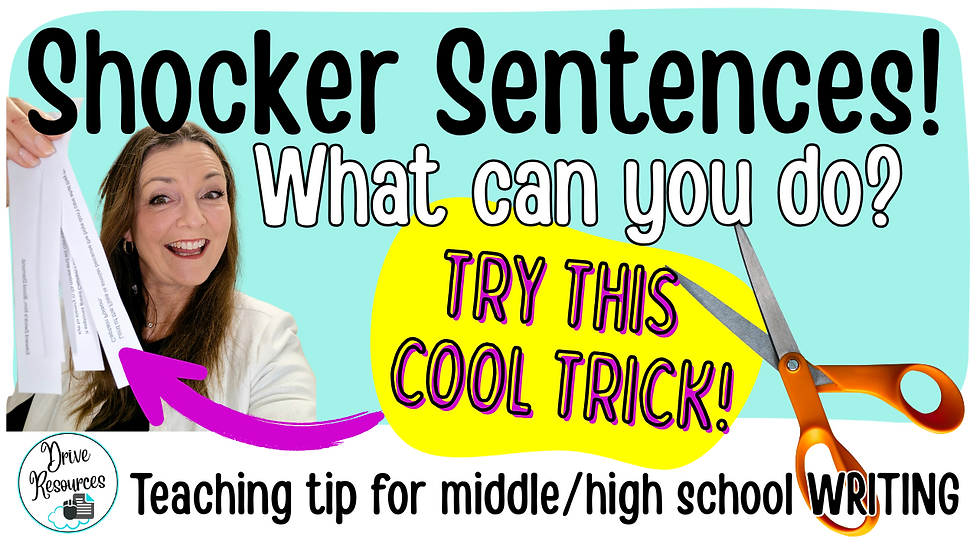
So, here's where the nifty trick to help with shocking sentence structures was born! In desperation, one lunchtime – and knowing I had Luke’s class next period – I took a piece of writing he'd shared with me electronically and hit ENTER twice after every full stop. This took each sentence down onto a new line and created a good space between each. I then printed his work and cut between each sentence so that each appeared on a separate strip of paper. I jumbled them up and popped them in the lid of one of my trendy teacher trays. (You know – the lid of one of those boxes that the reams of A4 paper come in!)

After lunch, I had Luke's class. Once everyone was working, I popped the tray of Luke's sentence strips in front of him. I asked him to read each strip and pop them on one side of his desk if they sounded ‘right' and on the other side if they didn't. You know what the piles looked like, eh?!
Luke was shocked. In fact, he called me back to his desk to ask me what the first few meant. I expected him to resort to ‘ye olde argument' – “Miss, you need to give me the whole thing. I can't see what this sentence means like this.” But he didn’t. I was surprised and impressed at his when he admitted that his writing was “a bit of a shocker, Miss”.
We once again had that discussion about how every sentence must make sense on its own. This time, with a more physical proof – Luke could see each sentence in isolation. I’m also a firm believer that the kinesthetic aspect – playing with the strips of paper – added and extra dimension (learning style) to help trigger an understanding that I hadn’t had any previous luck explaining.
Variations of this activity:
👇

Instead of you doing all the work, get the student to hit ENTER twice on a section of their writing (perhaps you could choose the section if you notice a particularly …ummm… ‘interesting’ paragraph). They might find seeing each sentence separated from the others at this point is enlightening enough. Otherwise, have them print the page, slice sentences up, mix the strips and read each one – just as I did for Luke except the student is doing the work!
👇
Have the student enter PAGE breaks at the end of each sentence so that each appears on a separate page. Rather than printing, have the student scroll through their document, looking at each sentence in isolation (because each is on its own page).
👇
If the student has written their work in an exercise book (notebook), choose a few ‘choice’ sentences and have them copy each onto a separate scrap of paper. As with our printed sentence strips, have the student shuffle each scrap so that they’re not in any order, therefore discouraging the assumption that something makes sense because of the sentence before/after that one.
Another cool trick (and just as effective TBH)!
Have students sentences in a backwards order – so, last sentence first. The student then reads the second to last sentence and so on all the way back up to the first sentence. This prevents students using previous sentences to help the one they’re reading make sense. I’ve found this easier for students if you get them to highlight the first word of each sentence first as it’s weirdly difficult to find the beginning of each sentence when you’re working backwards! (See the image below.)

Remember too, these two trusty old strategies:
ONE:
The reading aloud trick! Students must read:
Aloud
Slowly
With expression.
I’m always preaching this one to students and teachers alike! Seniors are particularly terrible at reading their work aloud because they have this idea that it’s a ‘baby’ thing to do, and they are also so impatient that they whizz through, not hearing what they’ve actually written and certainly not hearing where pauses and stops naturally fall…but are not punctuated!
TWO:
The grammatical explanation trick! Okay, hardly a trick, but...if sentences are incomplete, resort to grammar by getting the student to highlight first the verb, then the subject of their sentence. Go for the verb first because:
That’s easier to find, and
From there, the student can ask themselves WHO/WHAT is ‘doing’ the action, finding the subject of the sentence.
I know we always feel as though we’re racing to get through all that content, but stopping to fix a problem – especially one like non-sensical sentences which affect every facet of what you’re doing in class – is worth it in the long run.



*************************************
STAY IN THE KNOW!
✿ Subscribe to our YouTube channel
✿ Follow us on TikTok
✿ Follow us on Instagram
✿ Follow our Facebook page
✿ Follow us on TPT.
📬Add some joy to your inbox📬
🥝 NZ Teachers, click here to subscribe for teaching tips and our latest products (or log in to the website then you can access our Freebies library too)!
🌎 Teachers from other parts of the world, click here to subscribe for teaching tips and our latest plus get instant access to our bank of freebies!


Comments