


Already have the lesson? Let AI help you adapt it


There’s been a lot of discussion about using AI to create lesson plans, worksheets, quizzes, activities, and just about everything else a teacher might need. Type in the year level, topic, and learning objective, and a few seconds later you've got a lesson. Except, you haven’t saved yourself any work. You have to check everything, edit stuff you know won’t work, and before you know it, you’ve spent longer on it than you would have doing it yourself.
But what if you don't need another lesson plan?

Most of us already have plenty of lessons. We have resources we've created, resources we've bought, texts we've taught before, activities that have worked well, and folders full of material we've accumulated over the years. If anything, many of us have the opposite problem. We've got so much stuff that we can't always remember what we've got or where we put it.
The challenge isn’t creating something new, but making what we already have work for the class sitting in front of us. Perhaps a text you've taught successfully for years seems more difficult with this particular group. The instructions that worked perfectly well last year are just causing confusion. Some students need more support, while others are racing through everything you give them.
This is where I've found AI genuinely useful. Rather than asking it to plan for me, I can use it to analyse and adapt something I already have.
Start with the problem, not the prompt
It's very easy to open an AI tool and type something broad like:
Differentiate this activity for Year 9 students.
You'll certainly get an answer, and probably a very long one. The problem is that AI has to make a lot of assumptions before it can respond. It doesn't know why your students are struggling.
Is it the vocabulary?
Reading stamina?
Complicated instructions?
Lack of prior knowledge?
The amount they have to hold in their heads at once?
Or do they understand the material perfectly well but struggle to express their ideas in writing?
If you don't tell AI what the problem is, it has to decide for itself. That's when you can end up with a 'differentiated' version that makes the questions easier, shortens the text, reduces the writing, and adds sentence starters, whether students needed any of those things or not.
A more useful starting point is to ask AI to help identify where the difficulties might be before asking it to change anything. For example:
Look at this activity for a Year 9 English class. The learning goal is for students to analyse how the writer creates tension. Which parts of the activity might prevent students with weaker reading skills from demonstrating that skill? Don't rewrite the activity yet.
That last sentence matters. At this stage, I don't want AI to solve the problem. I want it to help me look at the activity from another angle. It might point out that a question contains several separate instructions, for example, or identify vocabulary I know won't be a problem because we've already covered it. I can then decide what is actually useful.
When a familiar text suddenly isn't working
I taught To Kill a Mockingbird many years ago. I'd taught the novel before, but this particular group found the language really difficult. They could discuss the characters and ideas when we talked about them together, but when they went back to the novel, unfamiliar expressions, dialect, vocabulary, and sentence structures kept getting in the way. So much of their attention was going into deciphering the language that they were losing track of what was actually happening.

If I'd had access to today's AI tools, I could have asked for a simplified version of each chapter, but I don't think that would have been the right solution. They were studying To Kill a Mockingbird. Harper Lee's language was part of the experience, not an inconvenience I needed to remove.
What could have helped was a quick way to identify the places where they were most likely to stumble. That would give me a useful starting point. I might decide to explain a couple of expressions beforehand, unpack a difficult sentence together, or give students some contextual information they need to make sense of what they're reading.
Sometimes we need to preserve the complexity of a text while finding better ways to support students through it.
Keep the learning, change the support
The same principle applies to activities. If the purpose of a lesson is to analyse how a writer creates a particular effect, students should still be doing that thinking. The difficulty may lie somewhere else.
Perhaps they can identify useful evidence but struggle to organise their explanation.
Perhaps the amount of reading before they reach the analytical task is overwhelming them.
Perhaps they understand the text when discussing it but freeze when faced with a blank page.
Those problems require different kinds of support, but none necessarily requires changing the learning goal. Once you've identified the likely barrier, you can be much more specific with AI:
These students can discuss their ideas verbally but struggle to turn them into analytical paragraphs. What light-touch scaffolds could I use without giving them the structure of the whole answer?
The phrase 'light-touch' is useful because AI has a tendency to be extremely helpful. Ask for a scaffold and you can find yourself with sentence starters for every sentence, a paragraph frame, vocabulary bank, checklist, and quite possibly a motivational speech. By the time it's finished, there's not always much thinking left for the student to do.
The same applies to extension. We've probably all had the student who finishes while everyone else has barely got started. Giving them another five questions isn't necessarily extension. Sometimes it's just rewarding efficiency with additional work.
Rather than asking AI to 'make this harder', I can show it the original activity and ask where it sees opportunities for greater depth.
Could students:
consider an alternative interpretation?
evaluate which evidence is most convincing?
explore an ambiguity?
make a connection across the text?
challenge an assumption in the original question?
Don't be afraid to argue with it
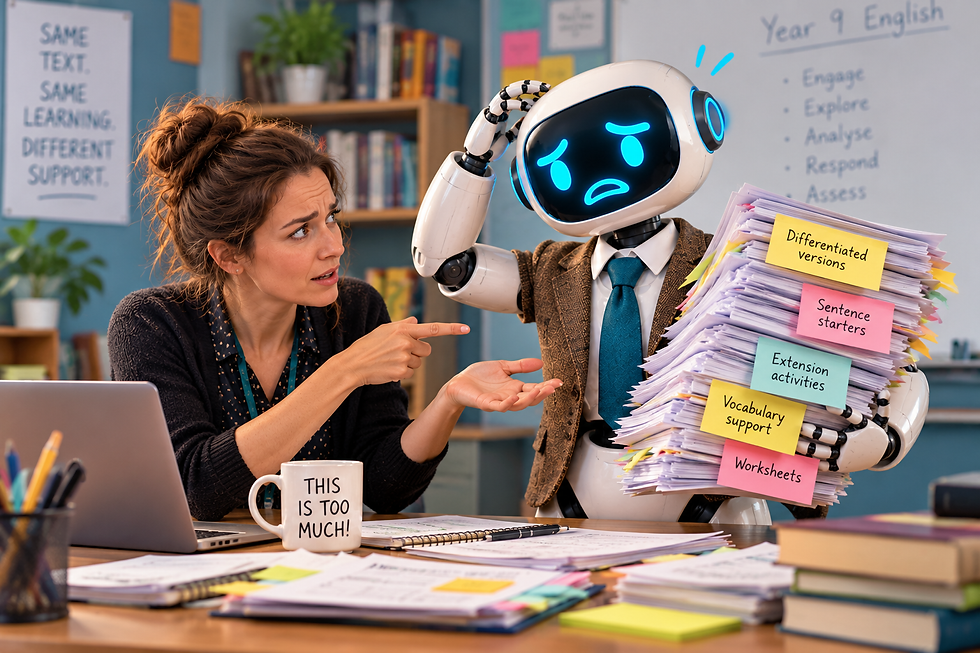
One of the biggest differences between using AI and searching online for an idea is that the conversation doesn't have to end with the first response. The first response is often where the useful bit starts.
If AI suggests simplifying a question that students need to learn how to tackle, tell it that won’t work. If a scaffold gives away too much of the thinking, say so. You can simply respond:
I don't want to simplify the question because students need to become familiar with this wording. What else could I change?
OR
That scaffold gives students too much of the answer. Suggest something that provides less support.
This is something I think gets lost when we talk about 'AI prompts', as though there is a magic combination of words that produces the perfect answer first time. I find it much more useful as a conversation where I can add information, reject suggestions, clarify what I meant, and keep narrowing things down until I've got something useful.
Use AI as a second pair of eyes

Another way I've found AI useful is asking it to look at something I've been working on for too long. Anyone who creates teaching materials will know the point where you've stared at a page so many times that you no longer see what's actually there. You know what an instruction is supposed to say, so your brain reads what you intended rather than what's on the page.
This is particularly useful with questions. I've written questions that seem perfectly clear to me, only to discover there are several reasonable ways to interpret them. Sometimes what looks like a straightforward question is actually more of a 'guess what's in the teacher's head' question. AI can help test this. Give it the text and question, without the answer, and ask what responses a student could reasonably give. If it comes back with several plausible answers, or interprets the question differently from the way you intended, the wording might need another look. Alternatively, those answers might be perfectly valid and need adding to the answer guide.
Older resources present another problem. Sometimes the answer guide has disappeared and, if we're honest, sometimes we never made one. The answers seemed obvious when we'd just taught the lesson. Several years later, perhaps not so much. You can give AI the original material and questions and ask it to draft possible answers based only on what you've provided. I'd still check everything carefully, particularly quotations and anything open to interpretation, but it's much quicker than recreating an answer guide from scratch.
More broadly, AI can look for unclear instructions, repetition, similar questions, gaps in an answer guide, or activities that don't quite match the learning goal. It's a useful way to look at an old resource with fresh eyes before putting it back in front of a class.
You don't always need another lesson
Sometimes what we need is a quick way to look at an existing lesson, activity, or text from a different angle. AI can help us spot potential problems, rethink the support we're providing, add more challenge, or breathe new life into an old resource.
And after all the years we've spent accumulating those resources, it seems a shame not to get as much use out of them as possible.
And yes... all the images in this blog were AI-generated!


STAY IN THE KNOW!
✿ Subscribe to our YouTube channel
✿ Follow us on TikTok
✿ Follow us on Instagram
✿ Follow our Facebook page
✿ Follow us on TPT.
📬Add some joy to your inbox📬
🥝 NZ Teachers, click here to subscribe for teaching tips and our latest products (or log in to the website then you can access our Freebies library too)!
🌎 Teachers from other parts of the world, click here to subscribe for teaching tips and our latest plus get instant access to our bank of freebies!


Comments