


A Structured Approach to Literacy at HIGH School!

Updated: Aug 25
Help for teachers of English/ELA

Structured literacy - or a structured APPROACH to literacy at HIGH school?! What's that?
Literacy at high school is about teaching students to become proficient readers and writers. But:
Ummmm…that’s a lot. Where do you begin, right?
What’s all this stuff about “structured literacy”?
Where does “the science of reading” fit into all this?
Structured literacy is about teaching reading and writing skills:
Explicitly – ie, actually teaching the skill then following through to check it’s understood, and to see that it’s used. So rather than “proofread your work” you:
Teach students how to proofread.
Regularly say to students, “Show me your work. Read this part to me.”
Systematically – ie, with logical sequencing so that you begin with core skills, check every student knows them, then build on. Again, check: does everyone understand this bit?
A structured literacy approach involves:
Classroom habits - without these, you might as well go home.
Teachers’ knowledge of reading sequences and skills.
Teachers’ knowledge of writing sequences and skills.
Formative assessment (a 'compulsory' dressed up as 'casual').
See the graphic below!

The science of reading is about how students learn to read. It includes things like:
Focusing on word knowledge – eg: phonics, morphology, decoding, comprehension.
Looking at language structures – sentences, syntax.
Thinking about how background/personal experiences and values affect our responses to what we read.
How oral language, reading and writing are connected.
How we learn to read fluently.
Unfortunately, when we hear the phrases “structured literacy” and “the science of reading”, many of us think phonics!
This is a small part of these concepts.
Get your mind off phonics. Instead, think about the Year 12 student reading Shakespeare.
They might have strong decoding skills, however why they’re struggling with the bard involves insufficient:
Vocabulary – in general, but also with archaic language.
Syntax knowledge (What? We can shuffle words around?!)
Background knowledge (Who talks like this, Miss?!)
Confidence with figurative language.
Confidence with the line structure and punctuation of verse.
Inferencing skills (Calm down and get the gist!)
Sure, know where students begin in year 0 (phonics etc), but then know the progression of literacy skills from there and where the level is at for high school.

A wee framework
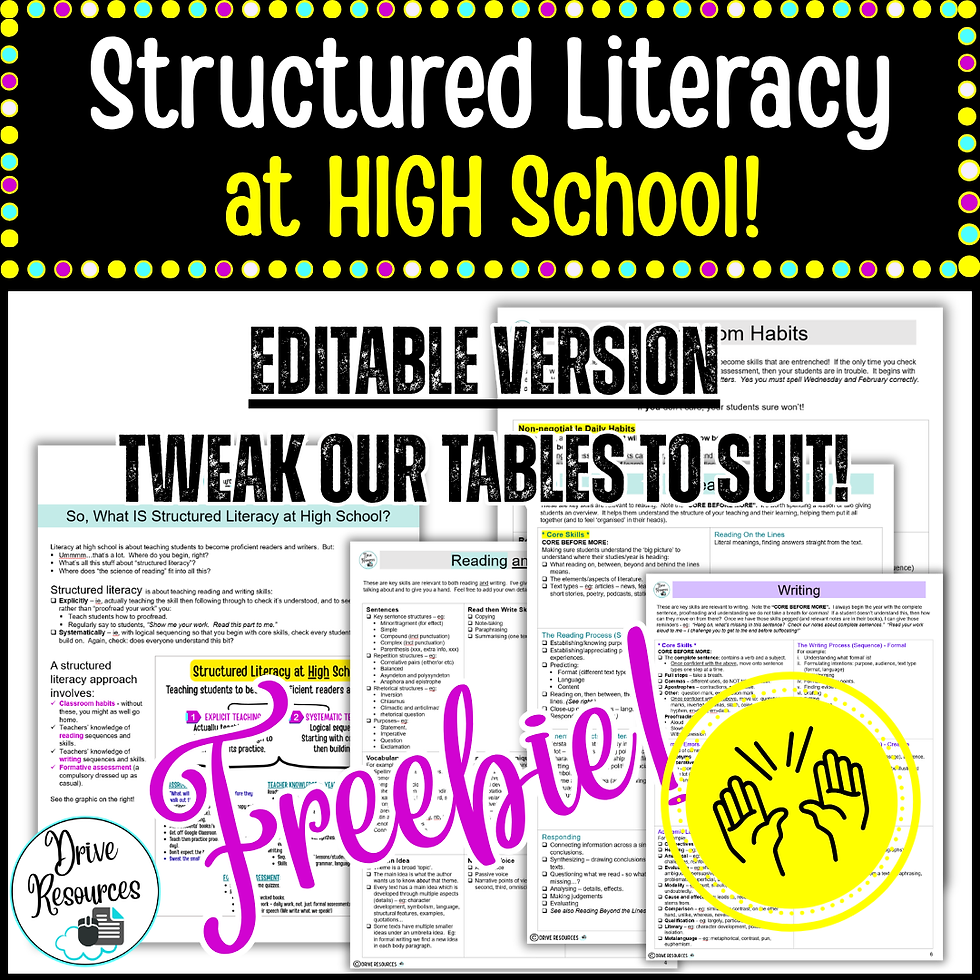
Here's a bit of a framework that might help. You can always reformat or edit the content in the editable version linked on the right, but I think this gives a decent overview!
Classroom Habits
Slow it down. Sweat the small stuff. Routines become habits…become skills…that are entrenched! ! If the only time you check students’ work or insist on accuracy is for a formal summative assessment, then your students are in trouble. It begins with the date. Write the date – in full. Yes, with capitals. Yes it matters. Yes you must spell Wednesday and February correctly. No, we’re not moving on until you do it.
If you don’t care, your students sure won’t!

Reading and Writing
These key skills are relevant to both reading and writing. I’ve given a few specifics in places so that you know what I’m talking about and to give you a hand. Feel free to add your own details.

Reading
These key skills are relevant to reading. Note the “CORE BEFORE MORE”. It’s worth spending a lesson or two giving students an overview. It helps them understand the structure of your teaching and their learning, helping them put it all together (and to feel ‘organised’ in their heads).

Writing
These key skills are relevant to writing. Note the “CORE BEFORE MORE”. I always begin the year with the complete sentence, proofreading and understanding we do not take a breath for commas! If a student doesn’t understand this, then how can they move on from there? Once we have those skills pegged (and relevant notes are in their books), I can give those reminders - eg: “Hang on, what’s missing in this sentence? Check our notes about complete sentences.” “Read your work aloud to me – I challenge you to get to the end before suffocating!”

I couldn't possibly have included every 'category' and detail, as I said earlier, but hopefully this gives you a good overview to play around with!


STA
Y IN THE KNOW!
✿ Subscribe to our YouTube channel
✿ Follow us on TikTok
✿ Follow us on Instagram
✿ Follow our Facebook page
✿ Follow us on TPT.
📬Add some joy to your inbox📬
🥝 NZ Teachers, click here to subscribe for teaching tips and our latest products (or log in to the website then you can access our Freebies library too)!
🌎 Teachers from other parts of the world, click here to subscribe for teaching tips and our latest plus get instant access to our bank of freebies!


Comments